



Language models see further than any of us.
Just not with their own eyes.
The Dwarfs of Chartres
An essay on artificial intelligence and the art of sitting on other people’s shoulders
Julian M. FlocktonTranslated from the German
Feed a language model nothing but the output of other language models, and nine rounds later a text about church towers has become a list of jackrabbits. Nine hundred years ago, a teacher at Chartres found the image for it in a single sentence.
Julian M. Flockton
In the summer of 2024 the journal Nature published an experiment that no one could have invented more neatly. A team led by Ilia Shumailov and Yarin Gal trained a language model on Wikipedia articles and set it to writing texts of its own.
Each new model learnt only from the texts of the one before, generation upon generation. Every generation was given the same opening, a passage on the building of English parish church towers in the Middle Ages, and left to carry on. In round one the subject was still churches, though suddenly papal basilicas in Rome. By round five architecture had gone altogether. In round nine the text began with the word “architecture” and then set about listing jackrabbits, black-tailed, white-tailed, blue-tailed, until it broke off.
The researchers call this model collapse. Anyone who wants an image for it that needs no statistics will find one in a Gothic cathedral.
What each generation makes of the same opening
Source text
The building of English parish church towers
Round 1
Suddenly, papal basilicas in Rome
Round 5
No architecture left, only a list of languages
Round 9
“Architecture”, then jackrabbits: black-tailed, white-tailed, blue-tailed …
Giants of glass
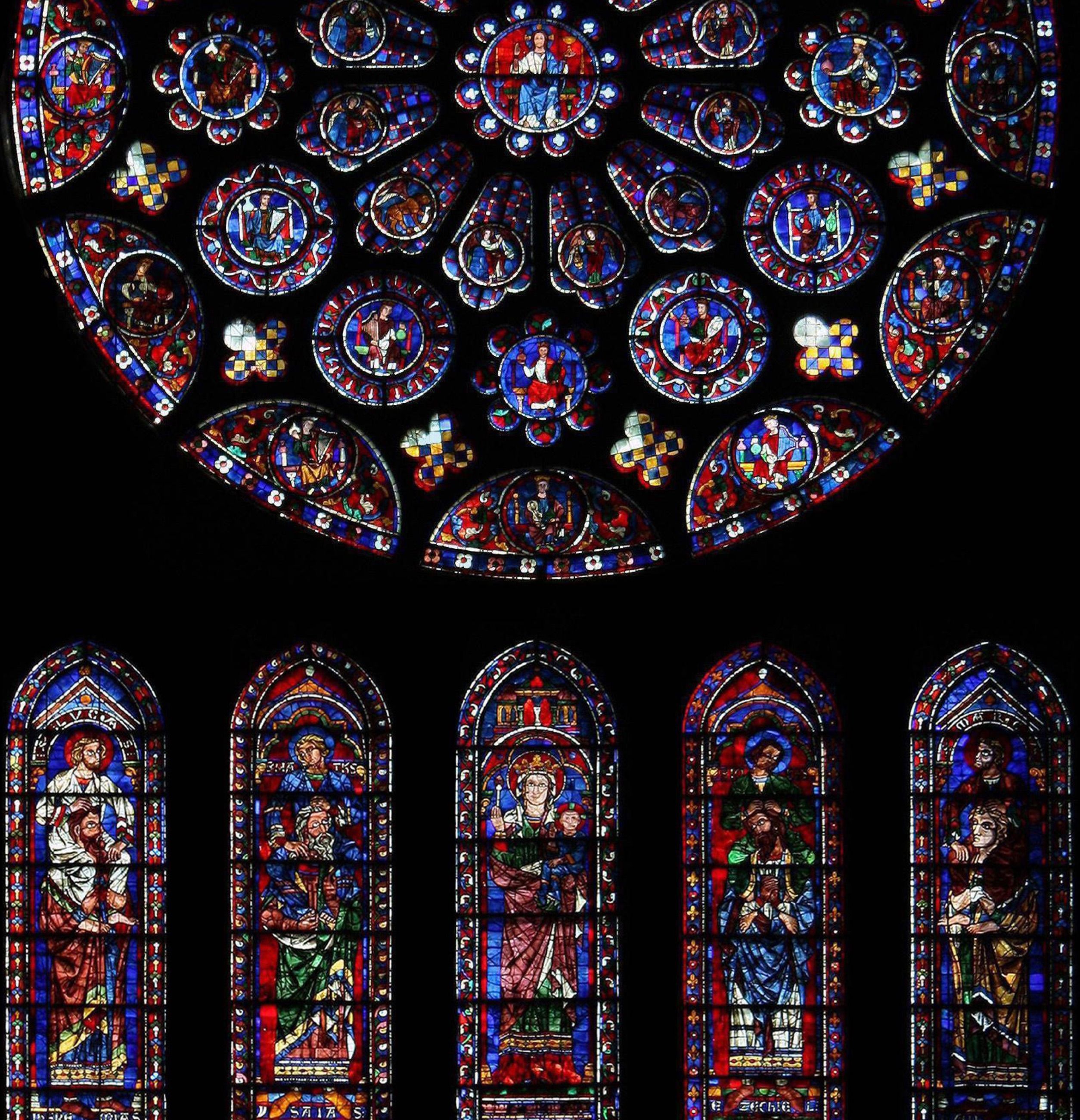
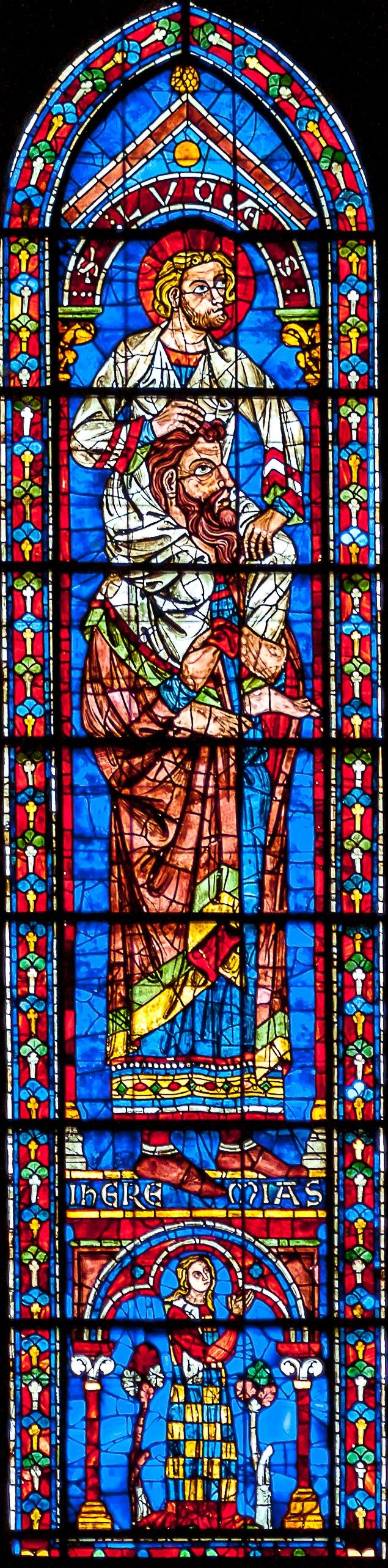
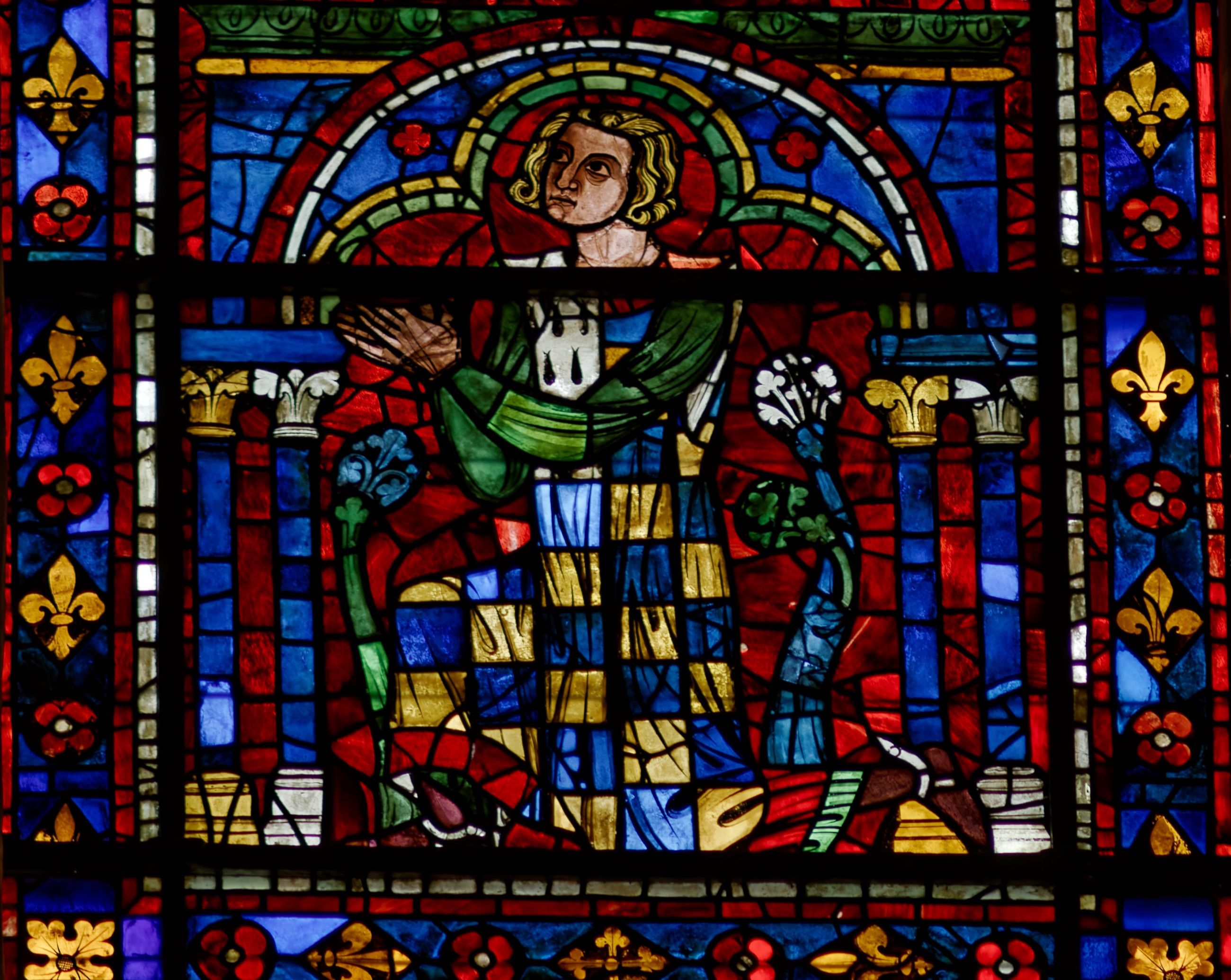
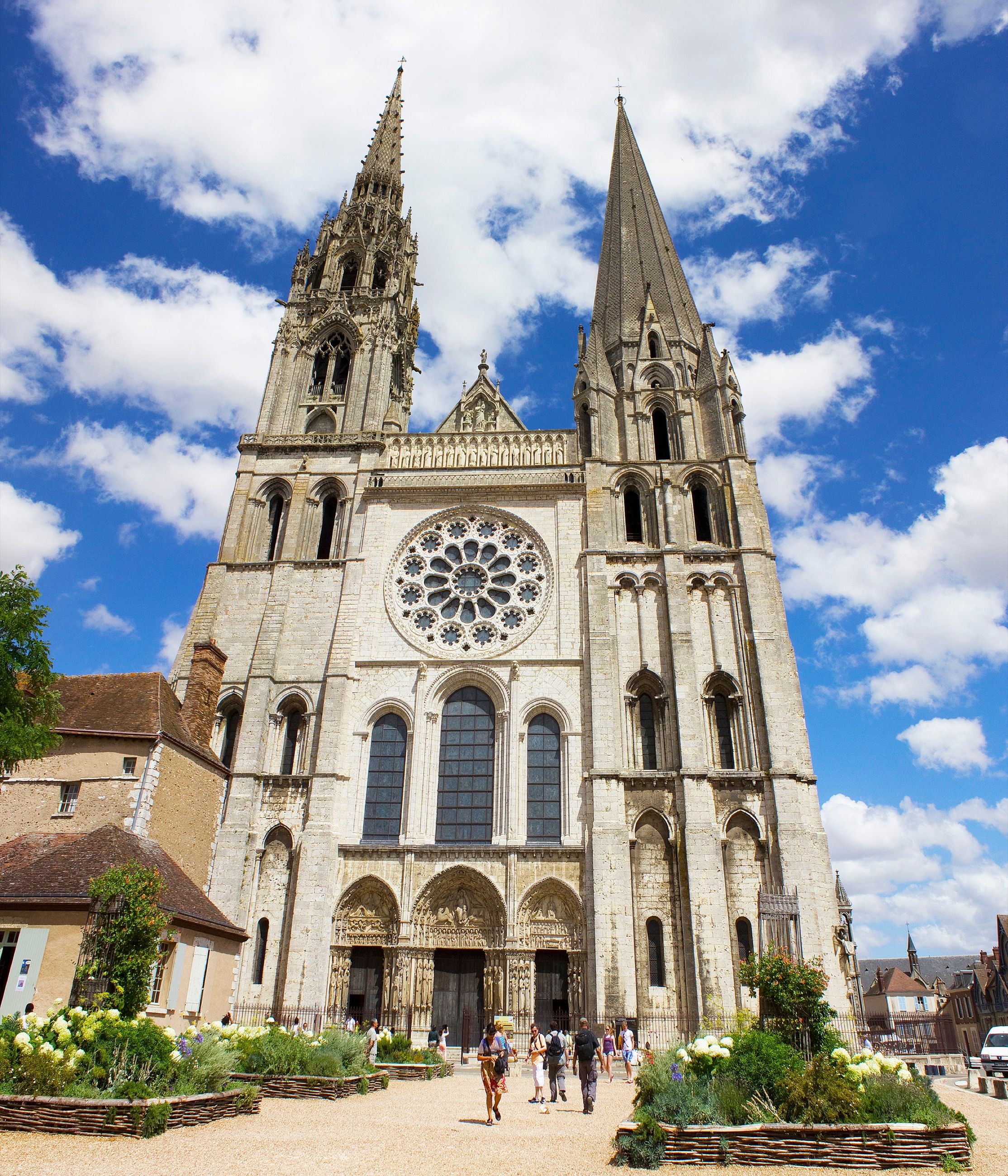
Stand beneath the south rose at Chartres and five tall lancet windows rise above you. In the centre the Virgin sits enthroned with the Child. On either side stand four giants in coloured glass, the major prophets of the Old Testament, and on their shoulders sit four much smaller men, the Evangelists. Luke sits on Jeremiah, Matthew on Isaiah, John on Ezekiel, Mark on Daniel. The windows were given around 1221 by Pierre Mauclerc, Duke of Brittany, who had himself and his family set into the glass below, as donors did.
Luke
on Jeremiah
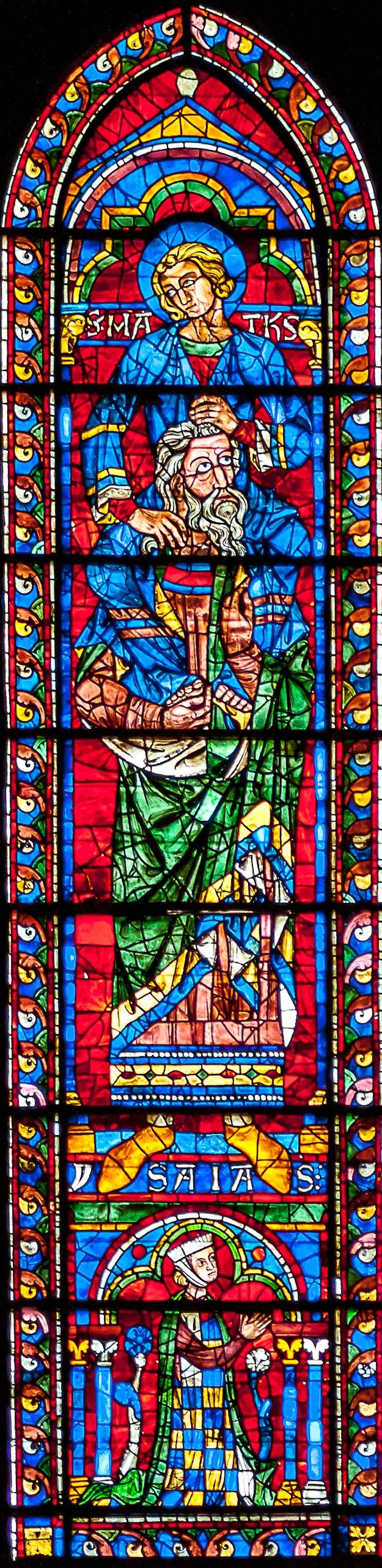
Matthew
on Isaiah
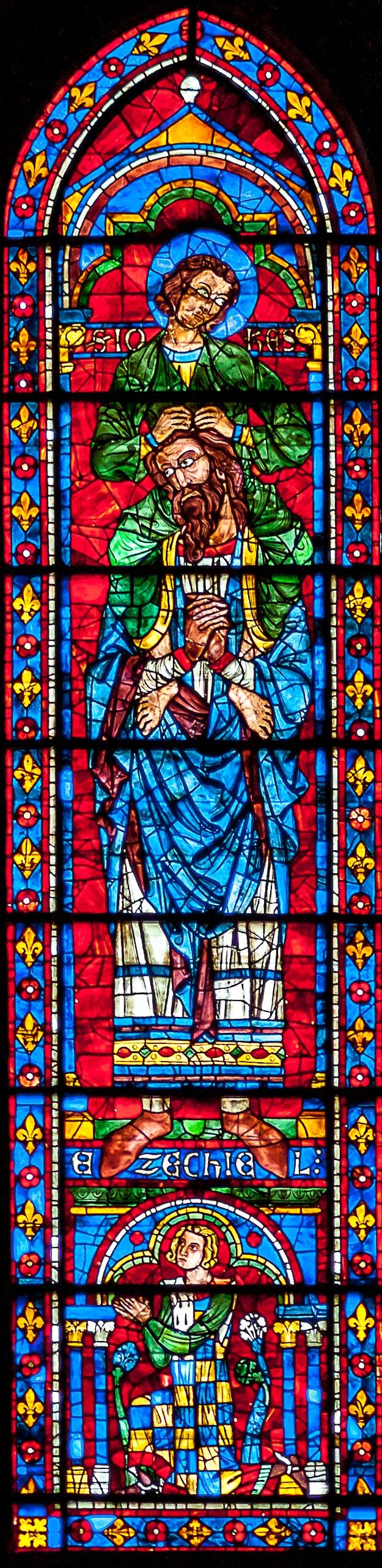
John
on Ezekiel
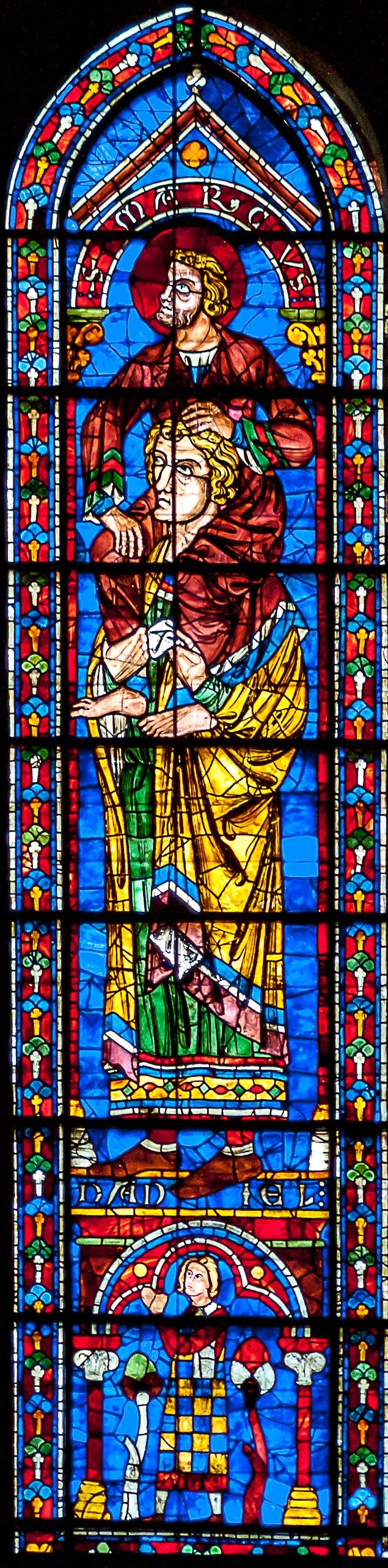
Mark
on Daniel
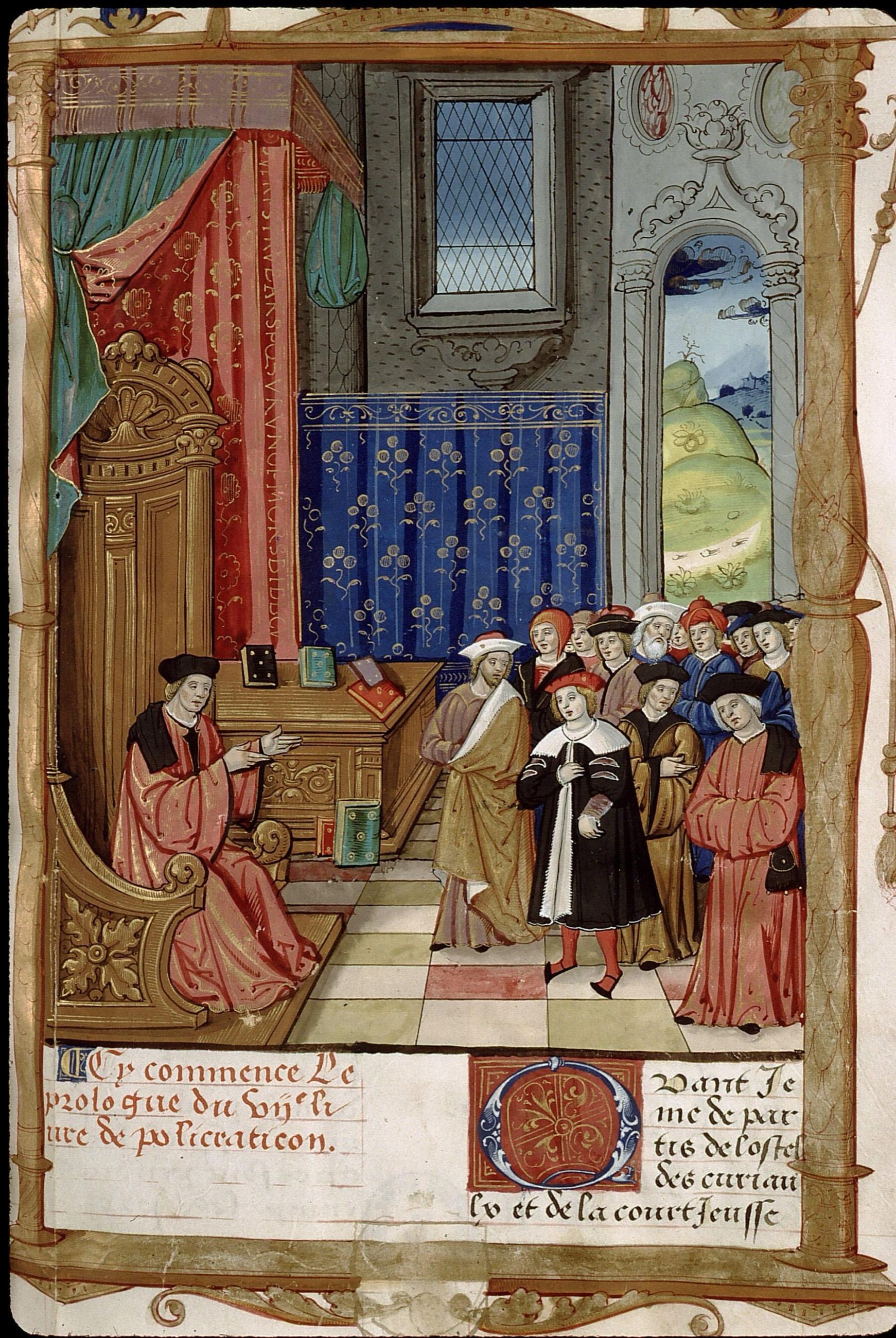
The picture is a quotation. Some hundred years earlier a man called Bernard taught at the cathedral school of Chartres. Next to nothing of his survives. He is remembered for one sentence, set down in 1159 by John of Salisbury, who had studied under Bernard’s own pupils:
Dicebat Bernardus Carnotensis nos esse quasi nanos, gigantium humeris insidentes, ut possimus plura eis et remotiora videre, non utique proprii visus acumine, aut eminentia corporis, sed quia in altum subvehimur et extollimur magnitudine gigantea.
Bernard of Chartres used to say that we are like dwarfs perched on the shoulders of giants. That is why we see more, and further, than they did: not because our own sight is any keener or our bodies any taller, but because the giants’ great stature lifts us up.
Two refinements went missing on the way. Bernard’s dwarfs do not stand; they sit, as comfortably as a child on its father’s shoulders at a carnival parade. And the sentence carries a modesty clause of its own: we see further, but not because we see better. We owe our advantage to the seat.
There is a quiet joke in how the sentence itself reached us. John writes dicebat, Bernard was in the habit of saying it, and the earliest written trace of the image probably comes from one of those pupils, William of Conches, in his glosses on Priscian’s Latin grammar, written before 1123. A parable about handing knowledge down, handed down by pupils and by the pupils of pupils. Bernard would have approved.
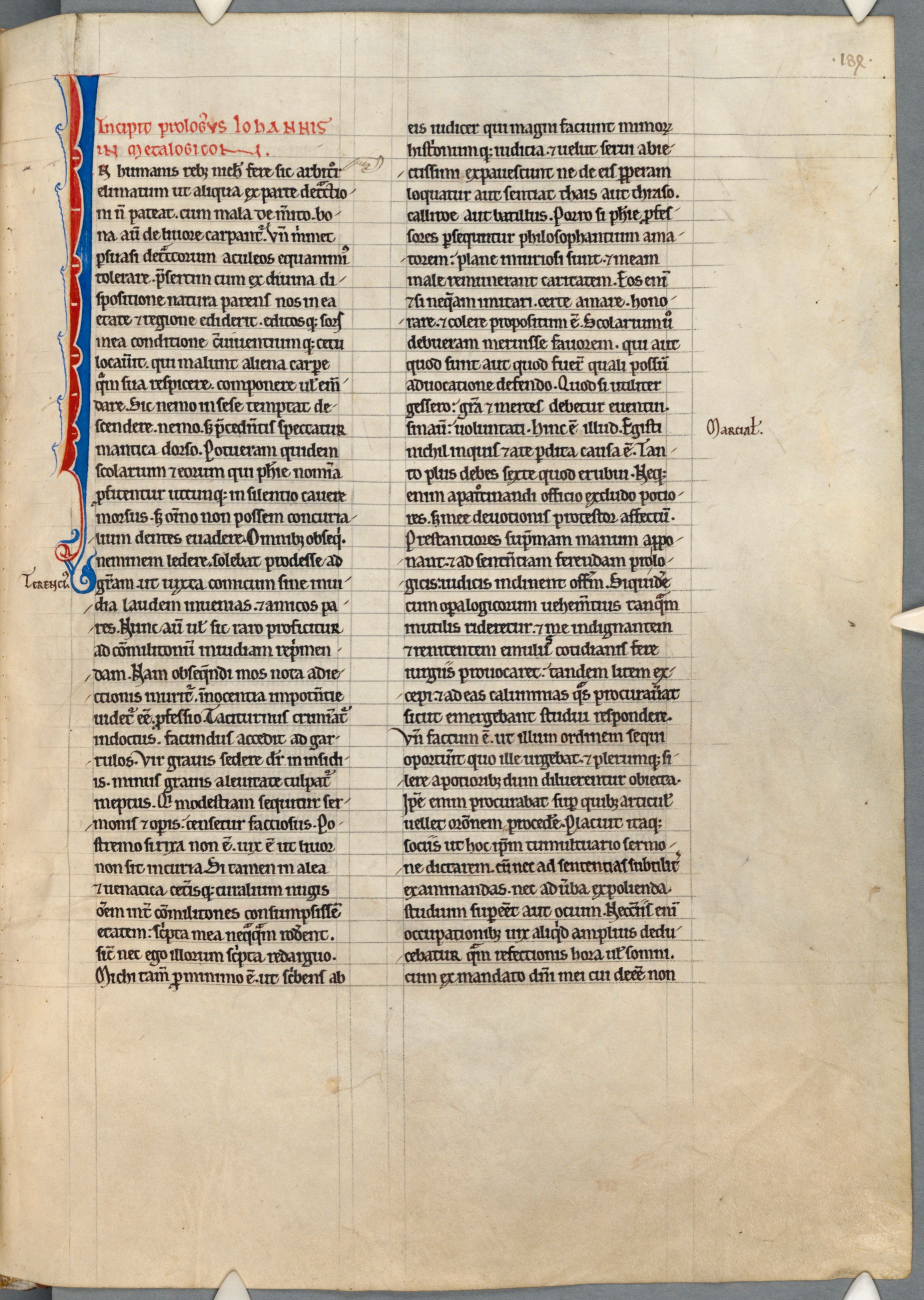
How a sentence passes from hand to hand
Good sentences travel. Around 1200 the image turns up in the Italian Talmudist Isaiah di Trani. In 1582 the Spanish Franciscan Diego de Estella used it, and in 1624 the Englishman Robert Burton borrowed it and dutifully named Estella as his source. Later editors then credited it to the Roman poet Lucan, in whose verse it is nowhere to be found. A plausible but invented attribution is, then, no invention of language models.
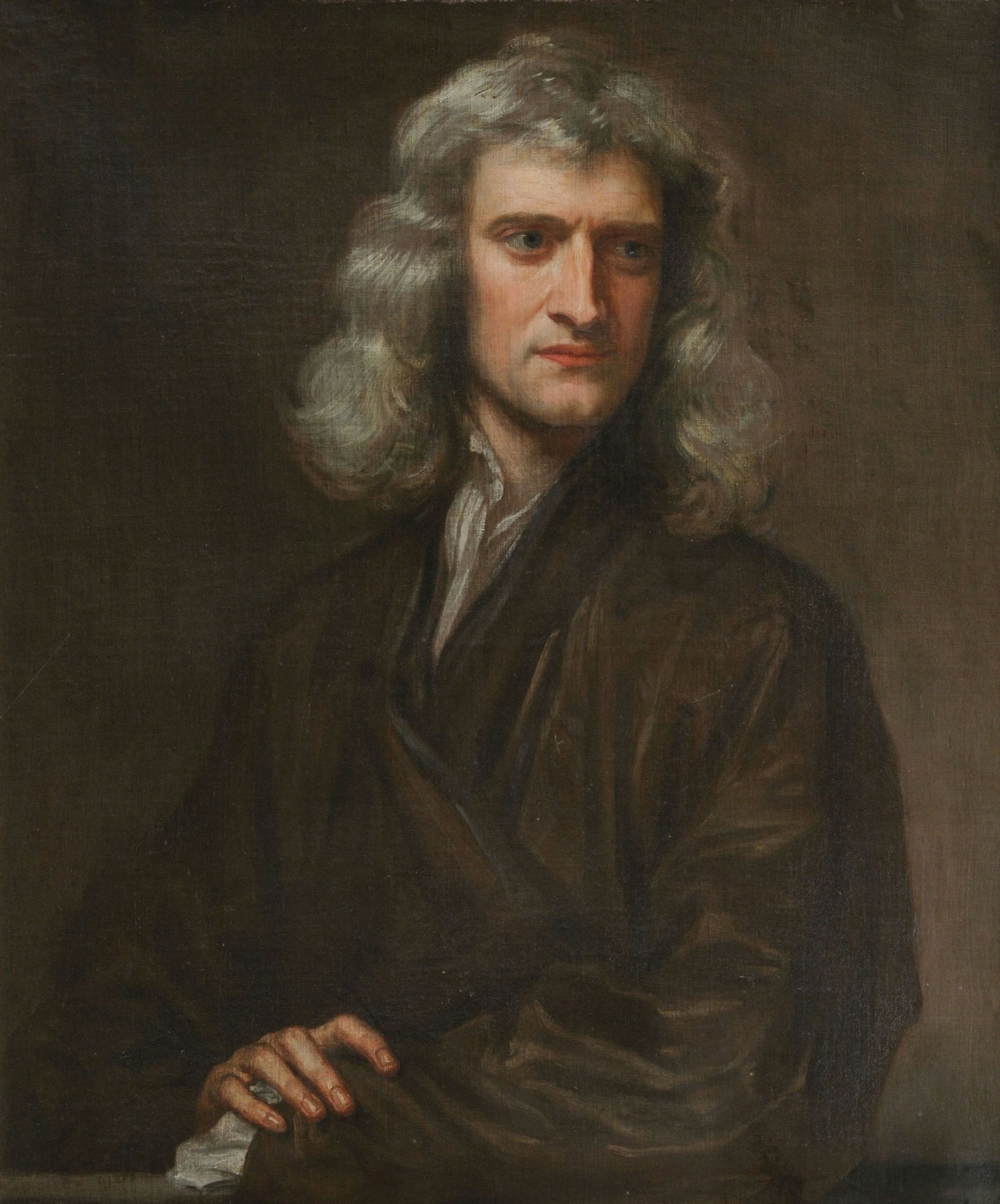
On 5 February 1676 Isaac Newton wrote to his rival Robert Hooke: “If I have seen further it is by standing on the shoulders of Giants.” In Newton the dwarf has vanished, leaving an “I” and the giants. Hooke was not short, but he was slight and badly stooped, and whether Newton’s “Giants” were a courtesy or a dig has been argued over ever since. The malice is unproven. It is simply too good to die.
In 1965 the sociologist Robert K. Merton devoted a whole book to the sentence’s wanderings, On the Shoulders of Giants, written in the digressive manner of Laurence Sterne’s Tristram Shandy, with footnotes that seem to want footnotes of their own. He shortened the title to OTSOG, which sounds like a battle cry and is an acronym for humility.
Then the sentence went mainstream. Since 1998 the sentence has run around the edge of the British two-pound coin. The reverse shows, in concentric rings, technological progress from the Iron Age to the internet; anyone with one in their pocket is carrying an essay on artificial intelligence that lacks only its final ring.

In a pub, Noel Gallagher read the inscription, scrawled it drunkenly on a cigarette packet and found beside it the next morning the note “bum title” where “album title” should have been. In February 2000 Oasis released Standing on the Shoulder of Giants, with a single shoulder. How a giant with one shoulder is supposed to carry a dwarf, the band never said.
Today the sentence sits beneath the search box of Google Scholar, the search engine for academic papers: “Stand on the shoulders of giants”. A ladder, not a telescope. The looking is still up to you.
The perfect dwarf
With large language models there is, for the first time, a figure to whom Bernard’s sentence applies to the letter, modesty clause and all. Some 60 per cent of the text on which a model such as GPT-3 was trained came from Common Crawl, an archive of automatically copied web pages, with books, Wikipedia and more besides. It has no view of the world of its own, no experience, no body. Whatever it sees, it sees from the shoulders of the people who wrote all that. Non proprii visus acumine, not by the keenness of its own sight: Bernard could not have written a more exact user manual.
Non proprii visus acumine
Not by the keenness of its own sight.
And yet this dwarf does see some things further than any single giant. It holds side by side texts that no one would ever have read together, the Talmudic commentary beside social security law, the Sterne novel beside the Python documentation. That is the height Bernard speaks of. It is borrowed.
Two things set the medieval dwarf apart from the mechanical one. The pupil at Chartres knew whose shoulders he sat on; he could name Plato and Priscian. The model cannot. In training, the giants have dissolved into numbers with no return address. In 2010 the film-maker Kirby Ferguson showed, in his video series Everything is a Remix, how Led Zeppelin took Jake Holmes’s “Dazed and Confused” without giving him credit. Holmes sued more than forty years later. Against a language model he would have had a harder time. Individual memorised passages can indeed be coaxed back out of a model, as a team led by Nicholas Carlini showed in 2021. For almost everything else, no one can say any longer which shoulder carried which sentence.
The second difference is subtler. The dwarf on the giant sees the same world as the giant, only further. The model sees no world at all, only texts about the world. In February 2023 the writer Ted Chiang, in the New Yorker, called ChatGPT® a blurry JPEG of the web, a lossy compression. He tells of a German building firm which noticed in 2013 that its Xerox photocopier had altered a floor plan: three rooms of 14.13, 21.11 and 17.42 square metres had all become 14.13 square metres in the copy. To save memory, the machine had merged digits that looked alike. The error was dangerous precisely because the wrong figures looked so tidy. For what language models occasionally make up, there is hardly a more exact picture.
Dwarfs on dwarfs
Which brings us back to the jackrabbits. Bernard’s image takes for granted something he never needed to say: that there really are giants at the bottom. The Nature experiment turned the arrangement upside down and stacked dwarfs on dwarfs. What goes first is telling. It is the edges, the rare, the improbable, the wayward. What remains is the commonplace, until that too stops making sense. Chiang had seen it coming in 2023, with his image of a photocopy of a photocopy.
From cathedral to jackrabbit in nine steps is the exact counter-image of the window at Chartres. There, prophets carry evangelists, and knowledge gains height. In the experiment each model carries only the imprint of the one before, and knowledge loses ground at every step.
Something very practical follows. The giants are not the famous names but everything written from first-hand observation: the floor plan with the right square metres, the field notes, the gloss in the margin. Anyone who uses language models to produce texts and puts them online, where the next models will learn from them, is working on the tower. Whether they add a giant or a dwarf depends on whether they have seen something that was not already in the data.
The blind giant
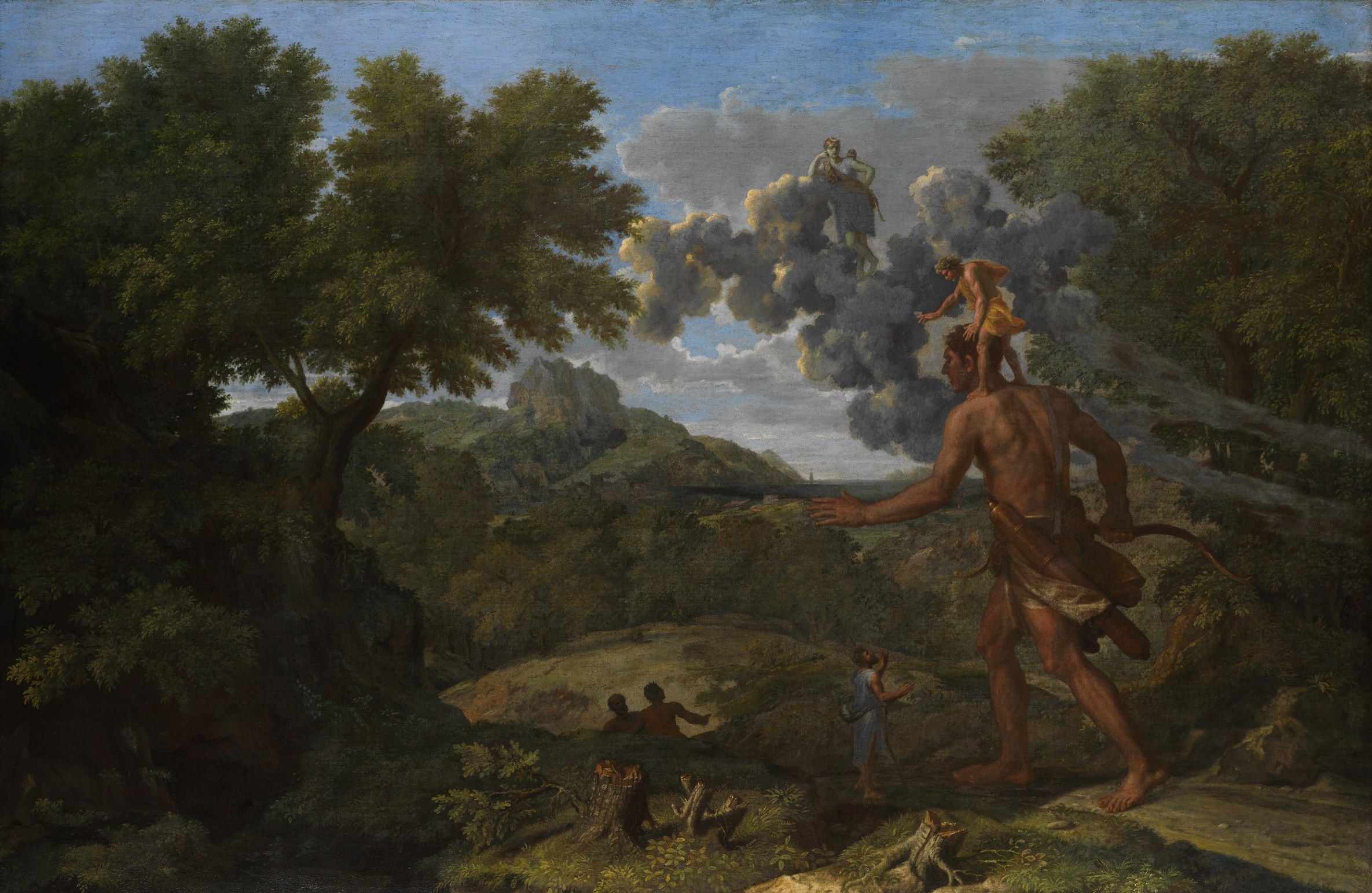
Nicolas Poussin, Blind Orion Searching for the Rising Sun, 1658. On the shoulders of the blinded hunter sits Cedalion, showing him the way to the sun.
The Metropolitan Museum of Art, New York, Fletcher Fund, 1924 (24.45.1). Open Access, CC0
In 1658, seven years before his death, Nicolas Poussin painted a picture in Rome that now hangs in the Metropolitan Museum in New York: Blind Orion Searching for the Rising Sun. The hunter Orion has been blinded and strides through the landscape as a giant. On his shoulders sits a small man, Cedalion, pointing him east, towards the rising sun that is to give him back his sight. The art historian Ernst Gombrich traced the scene to Lucian, the satirist of antiquity.
Poussin reverses the roles. The giant has the strength and no sight; the little man has the sight and no strength.
That fits our moment better than the windows of Chartres. Measured against its sources, a language model is a dwarf. Measured against the individual who uses it, it is a giant, built from the writing of millions. But it is a blind giant. It does not know where east lies, and no quantity of computing power replaces the judgement of whether a sentence is true, whether a floor plan carries the right figures, whether a text says anything new. The direction comes from the small figure on the shoulders, the one who knows his way around the world.
Poussin himself painted the picture with failing eyesight and a hand that may already have been trembling; the Met’s curators trace the almost pointillist touch of his late work to this. He was no longer working with the keenness of his own sight, but with everything he had learnt over decades about light and landscape. The museum counts the Orion among his greatest landscapes.
Julian M. Flockton
Translated from the German original, Die Zwerge von Chartres.
Sources and picture credits
Sources
- Ilia Shumailov et al.: AI models collapse when trained on recursively generated data. Nature 631 (2024), pp. 755–759.nature.com/articles/s41586-024-07566-y(opens in a new tab)
- John of Salisbury: Metalogicon III, 4 (1159). Latin text after the edition by C. C. J. Webb (1929); English translation by the author.
- Bernard of Chartres, William of Conches, Isaiah di Trani:en.wikipedia.org/wiki/Bernard_of_Chartres(opens in a new tab)fr.wikipedia.org/wiki/Des_nains_sur_des_épaules_de_géants(opens in a new tab)
- John of Salisbury’s teachers:en.wikipedia.org/wiki/John_of_Salisbury(opens in a new tab)
- South transept lancets, donor and dating:friendsofchartres.org/?p=2315(opens in a new tab)therosewindow.com/pilot/Chartres/w122abcde.htm(opens in a new tab)
- Estella, Burton, Lucan, Newton and Hooke:en.wikipedia.org/wiki/Standing_on_the_shoulders_of_giants(opens in a new tab)lindahall.org/about/news/scientist-of-the-day/isaac-newton-3(opens in a new tab)
- Robert K. Merton: On the Shoulders of Giants. A Shandean Postscript. New York: Free Press, 1965.
- Two-pound coin:en.wikipedia.org/wiki/Two_pounds_(British_coin)(opens in a new tab)
- Oasis:en.wikipedia.org/wiki/Standing_on_the_Shoulder_of_Giants(opens in a new tab)
- GPT-3 training data:arxiv.org/pdf/2307.03941(opens in a new tab)
- Kirby Ferguson:everythingisaremix.info(opens in a new tab)
- Ted Chiang: ChatGPT® Is a Blurry JPEG of the Web. The New Yorker, 9 February 2023.
- Nicholas Carlini et al.: Extracting Training Data from Large Language Models. USENIX Security 2021.arxiv.org/abs/2012.07805(opens in a new tab)
- Nicolas Poussin, Blind Orion Searching for the Rising Sun, 1658:metmuseum.org/art/collection/search/437326(opens in a new tab)
Picture credits
- Cover and lancet windows: Chartres Cathedral, south transept, bay 122. Photo: PtrQs, CC BY-SA 4.0, via Wikimedia Commons; details.creativecommons.org/licenses/by-sa/4.0(opens in a new tab)
- South rose of Chartres Cathedral. Photo: Schneider Ludwig, CC BY-SA 3.0, via Wikimedia Commons.creativecommons.org/licenses/by-sa/3.0(opens in a new tab)
- Donor panel, Pierre Mauclerc. Photo: Vladimir Renard, CC BY-SA 4.0, via Wikimedia Commons.creativecommons.org/licenses/by-sa/4.0(opens in a new tab)
- Metalogicon, opening page. Cambridge, Corpus Christi College, MS 046, fol. 184r. Public domain, via Wikimedia Commons.
- John of Salisbury teaching. Étienne Colaud, Paris, Bibliothèque Sainte-Geneviève, MS 1145, fol. 3r. Public domain, via Wikimedia Commons.
- Isaac Newton. Godfrey Kneller, 1689. Public domain, via Wikimedia Commons.
- Edge inscription of the two-pound coin: typographic rendering by the author.
- West front of Chartres Cathedral. Photo: Dcconsta, CC BY-SA 3.0, via Wikimedia Commons; detail.creativecommons.org/licenses/by-sa/3.0(opens in a new tab)
- Nicolas Poussin, Blind Orion Searching for the Rising Sun, 1658. The Metropolitan Museum of Art, New York, Fletcher Fund, 1924 (24.45.1). Open Access, CC0; cropped to the painted surface.